

Every year, thousands of Nigerian importers overpay on sea freight not because rates are high, but because they chose the wrong shipping method for their cargo volume. Some fill barely half a container and pay for the rest. Others ship 16 CBM via LCL and pay more than an FCL container would have cost, plus extra CFS fees at both ends.
This guide settles the comparison fully. By the time you finish, you will know exactly which option fits your business, how to calculate the break-even point, what every cost component looks like in both methods, and when to switch from LCL to FCL as your import volumes grow.
At Super Moonlight Logistics we handle both FCL and LCL shipments on regular China to Nigeria sailing schedules. This guide is built from real operational experience helping Nigerian importers across every product category, from electronics and clothing to auto parts, machinery, and consumer goods.
What Is FCL? Full Container Load Explained
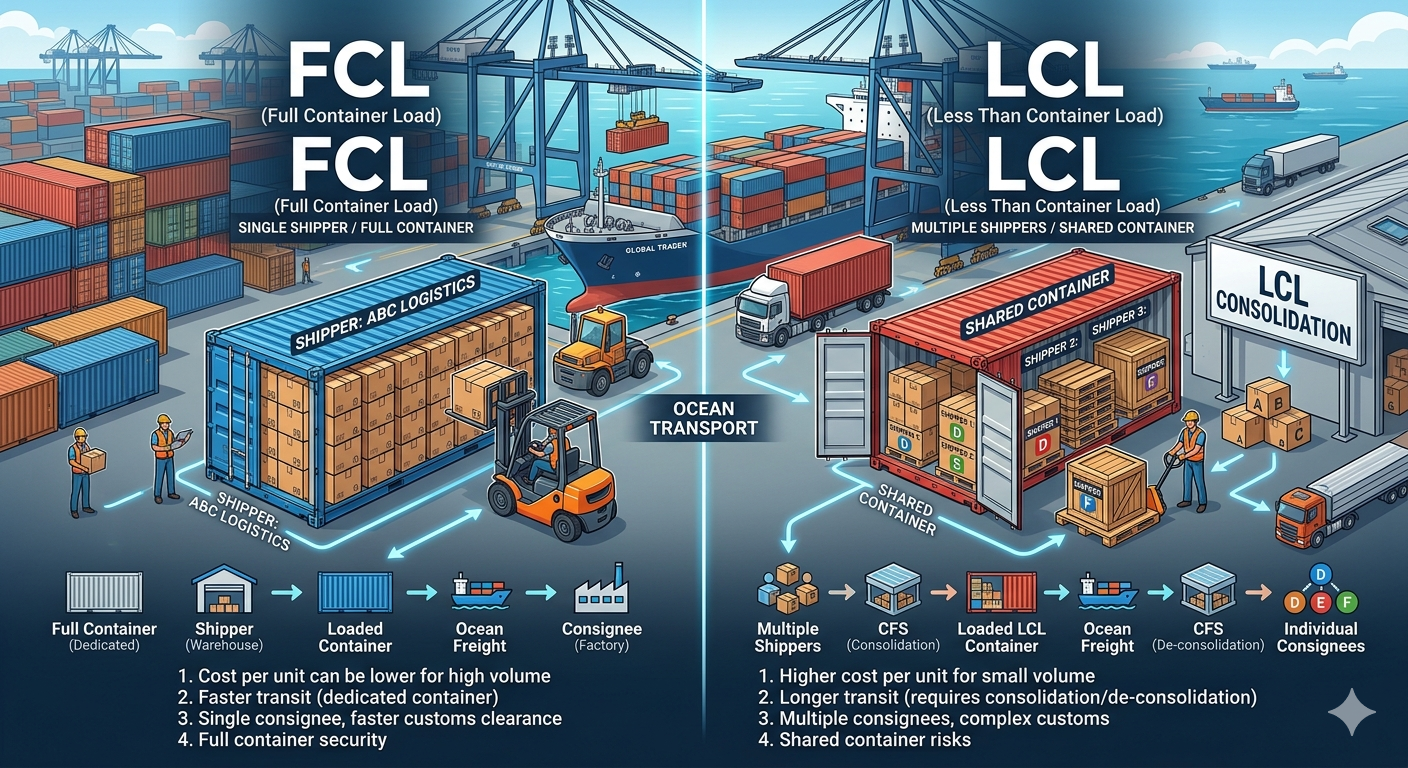
FCL (Full Container Load) means you book an entire shipping container exclusively for your cargo. No other importer’s goods enter your container. It is loaded at origin, sealed, and transported to the destination port without being opened until customs or final delivery.
You pay a flat rate for the container regardless of whether it is completely full. This is both the main advantage and the key risk: if your cargo fills 80% of a 20ft container, you get excellent per-CBM value. If it fills only 30%, you are paying for a large amount of empty space.
| Container Type | Internal Volume (CBM) | Max Payload (kg) | Best for |
| 20ft Standard | 28–33 CBM | ~25,000 kg | Medium-volume, dense or heavy goods |
| 40ft Standard | 58–67 CBM | ~27,000 kg | High-volume bulk cargo |
| 40ft High Cube (40HQ) | 65–68 CBM | ~26,000 kg | Voluminous, lightweight goods |
| 20ft Reefer | ~25 CBM | ~20,000 kg | Temperature-sensitive goods |
FCL is the natural choice for Nigerian importers who regularly fill containers. Our Ocean Freight service covers both FCL and LCL on weekly China to Nigeria sailing schedules from Guangzhou and Yiwu.
What Is LCL? Less Than Container Load Explained
LCL (Less Than Container Load) also called groupage shipping or cargo consolidation means your goods share a container with cargo from other importers. You pay only for the space your goods occupy, measured in cubic metres (CBM) or kilograms, whichever is higher under the W/M rule.
Your freight forwarder collects cargo from multiple importers, combines it at an origin Container Freight Station (CFS) in China, and ships it as one container. At Lagos, the container is deconsolidated at a destination CFS and each importer’s goods are released individually.
FCL vs LCL: Full Side-by-Side Comparison
| Factor | FCL | LCL |
| Container usage | Entire container (your cargo only) | Shared container with other importers |
| Cost structure | Flat rate per container | Per CBM or W/M (shared freight) |
| Best volume | 14+ CBM, single or few suppliers | 0.5–13 CBM, or multi-supplier orders |
| Transit time (China–Nigeria) | 28–33 days | 30–38 days (adds CFS waiting) |
| Cargo handling | Minimal (loaded once, sealed) | Multiple: origin CFS, ocean, destination CFS |
| Damage/contamination risk | Lower (no mixing, no extra handling) | Slightly higher multiple handling points |
| Customs clearance | One Bill of Lading (simpler) | Each HBL cleared individually |
| Demurrage risk | Higher (full container on your account) | Managed by forwarder across shared cargo |
| Flexibility | Lower (needs volume to justify booking) | Higher — ship small quantities any cycle |
| Scalability | Better for established/bulk importers | Better for startups and product testing |
Cost Breakdown: What You Actually Pay in FCL vs LCL
The single most common mistake when comparing FCL vs LCL is looking only at the base ocean freight rate. Both methods have multiple cost components and the final difference often sits in the charges that are not in the headline quote.
FCL Full Cost Structure
- Container booking (ocean freight): Flat rate per container. Typical 20ft FCL from Guangzhou to Lagos: $1,500–$2,800 depending on season and carrier.
- Origin charges: Container stuffing, terminal handling charges (THC) at Chinese port, VGM (Verified Gross Mass) fee.
- Ocean freight surcharges: Fuel surcharge (BAF), peak season surcharge (PSS), congestion surcharge where applicable.
- Nigerian customs clearance: Brokerage, PAAR processing, import duty (5–35% of CIF value), 7.5% VAT, CISS levy (1% of FOB value).
- Demurrage / detention (if applicable): $75–$150 per container per day at Lagos ports after free-time days expire.
- Last-mile delivery: Road transport from Apapa/Tin Can Island to your Lagos, Onitsha, Kano, or other warehouse.
LCL Full Cost Structure
- LCL ocean freight (W/M basis): Per CBM or per tonne, whichever is higher. Typical rate from Guangzhou to Lagos: $35–$75 per CBM depending on season.
- Origin CFS fees: Warehouse receipt, handling, and stuffing in China. Often $15–$30 per CBM — frequently excluded from headline quotes.
- House Bill of Lading (HBL) documentation fee: Issued per importer for their cargo portion.
- Destination CFS / deconsolidation fees: Unloading, sorting, and release at Lagos CFS. Can add $20–$40 per CBM — the most commonly missed LCL cost.
- Destination handling charges (DHC): Port and terminal fees on LCL cargo at Lagos.
- Nigerian customs clearance: Same components as FCL — brokerage, PAAR, duty, VAT, CISS — applied to your individual HBL declared value.
- Last-mile delivery: Road transport from Lagos CFS to your warehouse.
| Hidden LCL cost warning: Importers who receive a quote showing only the base ocean freight per CBM often underestimate total LCL cost by 40–60%. Destination CFS fees, deconsolidation charges, and documentation fees are standard but frequently excluded from first-pass quotes. Always request a full door-to-door all-in quote that includes every fee from origin to your Nigerian warehouse before comparing LCL vs FCL. |
The 15 CBM Rule: When FCL Becomes Cheaper Than LCL
The break-even point is the volume at which FCL becomes more cost-effective than LCL, typically falls between 13 and 15 CBM on the China to Nigeria route. This is known as the 15 CBM rule.
ForestLeopard’s 2026 cost comparison guide identifies 15 CBM as the standard LCL-to-FCL crossover point. Efanda Logistics similarly notes that once an LCL shipment reaches 15 CBM, cumulative LCL freight and destination CFS fees often surpass the flat rate of a 20ft FCL container. At 14 CBM utilization, a 20ft FCL is frequently the cheaper and safer choice.
The 15 CBM Decision Framework
| Under 8 CBM, LCL is almost always cheaper. Ship consolidated and save significantly vs booking a container. 8–13 CBM → Compare full landed cost carefully. At this volume, destination CFS and deconsolidation fees can tip the balance toward FCL — especially for high-value or fragile goods. 14–15 CBM → FCL is usually more economical. A 20ft container at 28–33 CBM capacity gives room to grow the shipment at a flat rate that beats LCL all-in pricing. 33+ CBM → 40ft FCL. At this volume, a 40ft container (58–67 CBM capacity) reduces per-CBM cost further. Key reminder: always calculate full landed cost — not just ocean freight — for your specific route, cargo type, and supplier location before deciding. |
Transit Time: FCL vs LCL from China to Nigeria (2026)
| Route | FCL Transit | LCL Transit | Notes |
| Guangzhou/Shenzhen → Lagos | 28–33 days | 31–38 days | LCL adds 3–7 days for CFS consolidation |
| Yiwu → Lagos (via Guangzhou hub) | 30–36 days | 33–40 days | Inland transport to Guangzhou CFS adds time |
| Shanghai → Lagos | 32–38 days | 35–42 days | Longer origin-to-port transit |
| Any China port via transshipment | +3–7 days additional | +3–7 days additional | Singapore or Dubai hub adds transit time |
FCL is consistently faster than LCL for two structural reasons. First, FCL cargo does not wait for the consolidation warehouse to fill before the container is sealed. Second, FCL customs clearance at Lagos port is handled under a single Bill of Lading. It is simpler and less prone to delays caused by documentation problems in another importer’s HBL in the same LCL container.
For genuinely time-sensitive cargo such as seasonal fashion items, electronics before a product launch, urgent spare parts, our Air Freight service provides 5–8 days door-to-door transit from China to Lagos, trading cost for speed.
How Incoterms Affect Your FCL vs LCL Decision
Incoterms 2020 (International Commercial Terms) define who is responsible for freight, insurance, and customs at each point in the supply chain. Your Incoterm agreement with your Chinese supplier directly determines how much control you have over your shipping method choice.
| Incoterm | Who Books Freight | Implication for FCL/LCL choice | Risk transfer point |
| EXW (Ex Works) | Nigerian importer | Full control — you choose FCL or LCL | At supplier’s factory |
| FOB (Free On Board) | Nigerian importer | Full control from port of origin onward | At Chinese port, goods on vessel |
| CIF (Cost Insurance Freight) | Chinese supplier | Supplier chooses shipping method — less importer control | At port of origin on loading |
| DDP (Delivered Duty Paid) | Chinese supplier | Supplier controls all freight and customs | At your warehouse in Nigeria |
| DAP (Delivered At Place) | Chinese supplier | Supplier controls freight to named destination | At named destination, before customs |
For most experienced Nigerian importers, FOB is the recommended Incoterm. Under FOB, your supplier handles Chinese export clearance and delivers goods to the port but you control the ocean freight booking. This means you choose your freight forwarder, shipping method, and sailing schedule. Under CIF or DDP, your Chinese supplier makes these decisions, and their preferred logistics provider may not offer the best rates or schedules on the Nigeria route.
For more on documentation requirements including Form M, SONCAP, and PAAR ,see our detailed guide: mistakes Nigerian importers make when shipping from China.
Cargo Safety: FCL vs LCL for Nigerian Importers
FCL security advantages
In an FCL shipment, your container is sealed at origin and not opened until customs at the destination port or your warehouse. This means zero contamination risk from other goods, minimal handling, and simpler customs clearance, that is, one shipper, one Bill of Lading.
- No mixing with other importers’ goods
- No handling by CFS warehouse staff at origin or destination (unless inspected by customs)
- Lower risk of damage, misplacement, or pilferage in transit
- If customs inspects your container, it affects only your shipment
LCL risk factors to manage
LCL cargo passes through more handling points than FCL, origin CFS, ocean transit, destination CFS deconsolidation. Each step is professionally managed, but each introduces a small incremental risk that robust packaging and clear labelling mitigate.
A critical risk specific to Nigerian ports is the fact that if one importer’s cargo in a shared LCL container is flagged by Nigerian Customs, the entire container may need examination before any goods are released thus, causing demurrage and delays for all importers in that container. This is why choosing a freight forwarder who rigorously vets all documentation before consolidation matters significantly.
Our Customs Clearance service includes pre-clearance documentation review for all cargo in our consolidation containers, reducing the risk that one importer’s documentation error triggers port delays for others.
Demurrage and Detention: The Charges That Can Erase Your Profit Margin
Demurrage is charged when a container is not collected from the port terminal within the shipping line’s free-time window, typically 3–7 days after vessel arrival. At Apapa and Tin Can Island, demurrage runs $75–$150 per container per day and accumulates rapidly during port congestion periods.
Detention is a separate charge for retaining the container itself (outside the port) beyond the carrier’s allowed free-use period. Detention applies to FCL shipments; LCL importers face CFS storage charges instead if goods are not collected promptly after deconsolidation.
| Charge | FCL | LCL | How to prevent it |
| Demurrage | High risk — entire container on your account | Shared — forwarder manages across consolidated group | Submit PAAR before vessel arrival; clear promptly |
| Detention | Applies to empty container return | Not applicable | Return empty container within free days |
| CFS storage (LCL) | N/A | Accrues if goods not collected from CFS fast | Coordinate collection day after customs release |
| Port congestion surcharge | Both FCL and LCL affected | Both FCL and LCL affected | Use forwarder tracking vessel ETAs proactively |
Working with a logistics partner who submits the Pre-Arrival Assessment Report (PAAR) via the Nigerian Customs Service portal before the vessel arrives and coordinates port release within free-time days is the most effective way to avoid demurrage on both FCL and LCL. Our Customs Clearance team does this as standard practice for every shipment we handle.
Which Should You Choose? Four Real Business Scenarios
Scenario 1: First-time importer, small test order (2–5 CBM)
A Lagos clothing retailer is importing their first order from Guangzhou approximately 3 CBM, 200kg. LCL is clearly right. Booking an FCL container would mean paying for 25+ CBM of empty space. LCL pays for exactly 3 CBM, and the business ships on the next available consolidation cycle.
Compression advantage: clothing at 3 CBM can often be reduced to 1.5–2 CBM using our Compressing Goods service, cutting the LCL freight cost by 30–50% before the shipment enters the container.
Scenario 2: Growing electronics importer (10–14 CBM per cycle)
An Onitsha dealer imports phones, accessories, and cables that is approximately 12 CBM per month. This is the compare-carefully zone. At current China–Nigeria LCL rates plus destination CFS fees, 12 CBM LCL may cost as much as a 20ft FCL. Electronics also benefit from FCL’s sealed-container security. The right answer requires running a full landed cost comparison for both options at this specific volume and route.
Scenario 3: Established bulk importer (20+ CBM per cycle)
A Lagos auto parts distributor consistently imports 20–25 CBM per shipment. FCL is unambiguously right. The flat 20ft container rate beats LCL per-CBM pricing decisively at this volume. The business also benefits from better cargo security, faster transit, and simpler single-HBL customs clearance.
Scenario 4: Multi-supplier importer across several factories
A Kano fabric importer sources from 4 suppliers across Guangzhou and Yiwu. Total volume is 18 CBM per cycle but from multiple origins. Standard LCL on separate shipments would be expensive and complex. The right solution is buyer’s consolidation where suppliers deliver to one warehouse in Guangzhou, goods are consolidated, and the combined volume ships as a single optimized consignment.
Our Booking and Loading service is specifically structured for multi-supplier buyer’s consolidation — coordinating collection across multiple Chinese cities and consolidating into one shipment to Lagos.
Frequently Asked Questions
What is the main difference between FCL and LCL shipping?
FCL (Full Container Load) means you rent an entire container exclusively for your cargo and pay a flat rate regardless of fill level. LCL (Less Than Container Load) means your cargo shares a container with other importers, and you pay per cubic meter (CBM) or tons whichever is higher under the W/M rule. FCL is more cost-effective above 14 CBM; LCL is more cost-effective for smaller shipments.
What is the 15 CBM rule?
The 15 CBM rule is the approximate break-even point at which FCL becomes cheaper than LCL on most international routes including China to Nigeria. Below 15 CBM, LCL is usually more cost-effective. At or above 15 CBM, the flat rate of a 20ft FCL container typically beats the combined LCL ocean freight plus origin and destination CFS fees. Always calculate full landed cost for your specific route before deciding.
What are the dimensions and capacity of a 20ft and 40ft container?
A standard 20ft container holds approximately 28–33 CBM and can carry up to approximately 25,000 kg of cargo. A standard 40ft container holds 58–67 CBM with similar payload. A 40ft High Cube (40HQ) provides 65–68 CBM with 30cm of extra internal height ideal for voluminous, lightweight goods. Confirm exact internal dimensions and weight limits with your freight forwarder before planning your load.
What are the hidden costs in LCL shipping?
The most commonly missed LCL costs are: origin CFS fees (consolidation warehouse handling in China, $15–$30/CBM), destination CFS deconsolidation fees ($20–$40/CBM at Lagos), destination handling charges (DHC), HBL documentation fee, and last-mile delivery. These can add 40–60% on top of the base ocean freight rate. Always request a full all-in quote that includes every fee from origin to your Nigerian warehouse.
What is demurrage and how do I avoid it at Lagos ports?
Demurrage is the daily charge imposed by shipping lines when a container is not collected from the port terminal within the free-time period typically 3–7 days after vessel arrival. At Apapa and Tin Can Island, demurrage runs $75–$150 per container per day. Avoid it by: (1) ensuring all customs documentation including Form M and PAAR is submitted before vessel arrival; (2) working with a freight forwarder who proactively tracks ETAs and coordinates advance clearance; (3) having your customs broker ready to process duty payment on arrival day.
Which Incoterm gives me the most control over FCL vs LCL choice?
FOB (Free On Board) gives Nigerian importers full control over the ocean freight booking. Under FOB, your Chinese supplier handles export clearance and port loading, but you choose your freight forwarder, shipping method (FCL or LCL), and sailing schedule. Under CIF or DDP, your supplier makes these decisions. For experienced importers, FOB is almost always the recommended Incoterm.
Is LCL or FCL better for a new Nigerian importer?
LCL is almost always the right starting point. It allows you to import small quantities to test product quality and market demand without committing to full container volumes. It keeps capital requirements low and gives access to professional customs clearance support. As your regular import volume grows toward 14+ CBM per cycle, transition to FCL for better per-unit economics.
Make the FCL vs LCL Decision Based on Data, Not Guesswork
The FCL vs LCL decision comes down to four variables: cargo volume (CBM), required transit speed, cargo sensitivity, and the full landed cost comparison including all fees on both sides. Most Nigerian importers should start with LCL and transition to FCL when their regular import volume consistently reaches 14–15 CBM per cycle.
That transition made at the right time with the right logistics partner typically reduces freight cost per unit by 20–35% compared to continuing LCL at the same volume. It also simplifies customs clearance, reduces cargo handling risk, and produces more predictable delivery timelines.
Super Moonlight Logistics runs regular FCL and LCL schedules from Guangzhou and Yiwu to Lagos every week. Whether you are shipping 2 CBM or 40 CBM, we can run a full landed cost comparison for both options at your specific volume and route at no charge. Request your free freight comparison here and our team will respond within one business day.
