

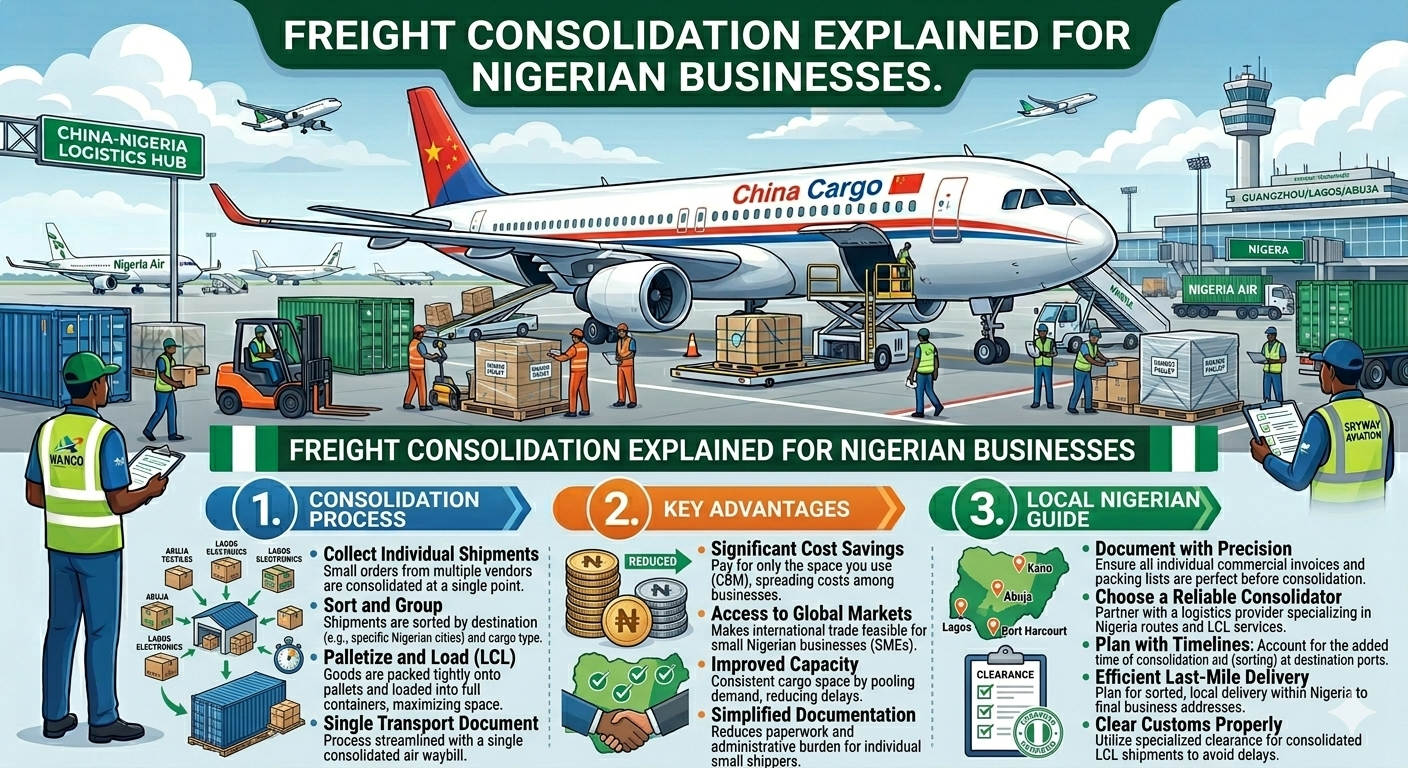
For many Nigerian importers, shipping costs are one of the biggest business expenses. Whether you import electronics, fashion items, auto parts, or machinery, logistics can significantly affect your profit margins. One powerful strategy that successful importers use to reduce costs and improve efficiency is freight consolidation.
But what exactly is freight consolidation and how does it benefit Nigerian businesses?
Let’s break it down.
What Is Freight Consolidation?
Freight consolidation is the process of combining multiple smaller shipments into one larger shipment before transporting them internationally. Instead of shipping goods separately from different suppliers, the cargo is gathered in one warehouse (usually in China), combined into one shipment, and then sent together to Nigeria.
This approach reduces shipping costs, minimizes documentation charges, and improves overall logistics efficiency.
Why Freight Consolidation Matters for Nigerian Importers
Many Nigerian businesses source goods from multiple suppliers in cities like Guangzhou and Yiwu. If each supplier ships independently:
- You pay separate freight charges
- You pay multiple documentation fees
- You increase customs processing complexity
- You risk higher overall shipping costs
Freight consolidation solves these problems by centralizing your cargo before shipment. For businesses shipping from China to Nigeria regularly, consolidation can significantly improve cost control.
How Freight Consolidation Works
Here’s how the process typically works:
1️. Supplier Delivery to Warehouse
2️ Inspection and Sorting
3️ Repacking and Compression
4️. Combined Shipment
All goods are loaded together into:
- A shared container (LCL – Less than Container Load), or
- A full container (FCL – Full Container Load), or
- A consolidated air freight shipment
5️. Shipment to Nigeria
6️. Customs Clearance and Delivery
Key Benefits of Freight Consolidation
1. Lower Shipping Costs
Freight consolidation reduces per-unit shipping costs because:
- You share container space efficiently
- Documentation fees are reduced
- Handling charges are minimized
2. Reduced Volumetric Charges
Air freight and even some sea freight rates depend on volume.
Repacking and compressing goods reduces:
- Chargeable weight
- Empty carton space
- Shipping cost per cubic meter
3. Simplified Customs Clearance
Instead of processing multiple shipments, customs clearance is handled as one coordinated shipment.
This reduces:
- Documentation errors
- Delays
- Risk of demurrage charges
4. Better Inventory Planning
With consolidated shipments:
- Goods arrive together
- Inventory is easier to manage
- Distribution planning becomes more efficient
LCL vs FCL: Understanding Consolidation Types
LCL (Less than Container Load)
- You share container space with other importers
- Ideal for smaller shipments
- More affordable for growing businesses
FCL (Full Container Load)
- You use an entire container
- Suitable for large-volume importers
- Lower cost per unit at scale
When Should Nigerian Businesses Use Freight Consolidation?
Freight consolidation is ideal when:
- You buy from multiple suppliers
- Your cargo volume is small to medium
- You want to reduce freight cost
- You are importing regularly
- You want better packaging and handling
Common Mistakes to Avoid
Even with freight consolidation, mistakes can increase costs:
- Poor coordination between suppliers
- Incorrect cargo labeling
- Incomplete documentation
- Choosing inexperienced freight agents
How to Choose the Right Freight Consolidation Partner in Nigeria
Before selecting a logistics partner, check for:
✔ Warehousing presence in China
✔ Experience in China–Nigeria trade
✔ Transparent pricing
✔ Customs clearance expertise
✔ Cargo tracking system
✔ Reliable customer support
Freight consolidation is one of the smartest logistics strategies for Nigerian businesses importing from China.
By combining shipments, optimizing packaging, and coordinating documentation properly, businesses can:
- Reduce shipping costs
- Improve efficiency
- Minimize customs risks
- Increase overall profitability
In today’s competitive market, smart logistics planning is no longer optional, it is essential for business growth. If your business imports regularly, freight consolidation could be the key to improving your margins and scaling confidently.
Visit Super Moonlight Logistic to learn about our services.
