

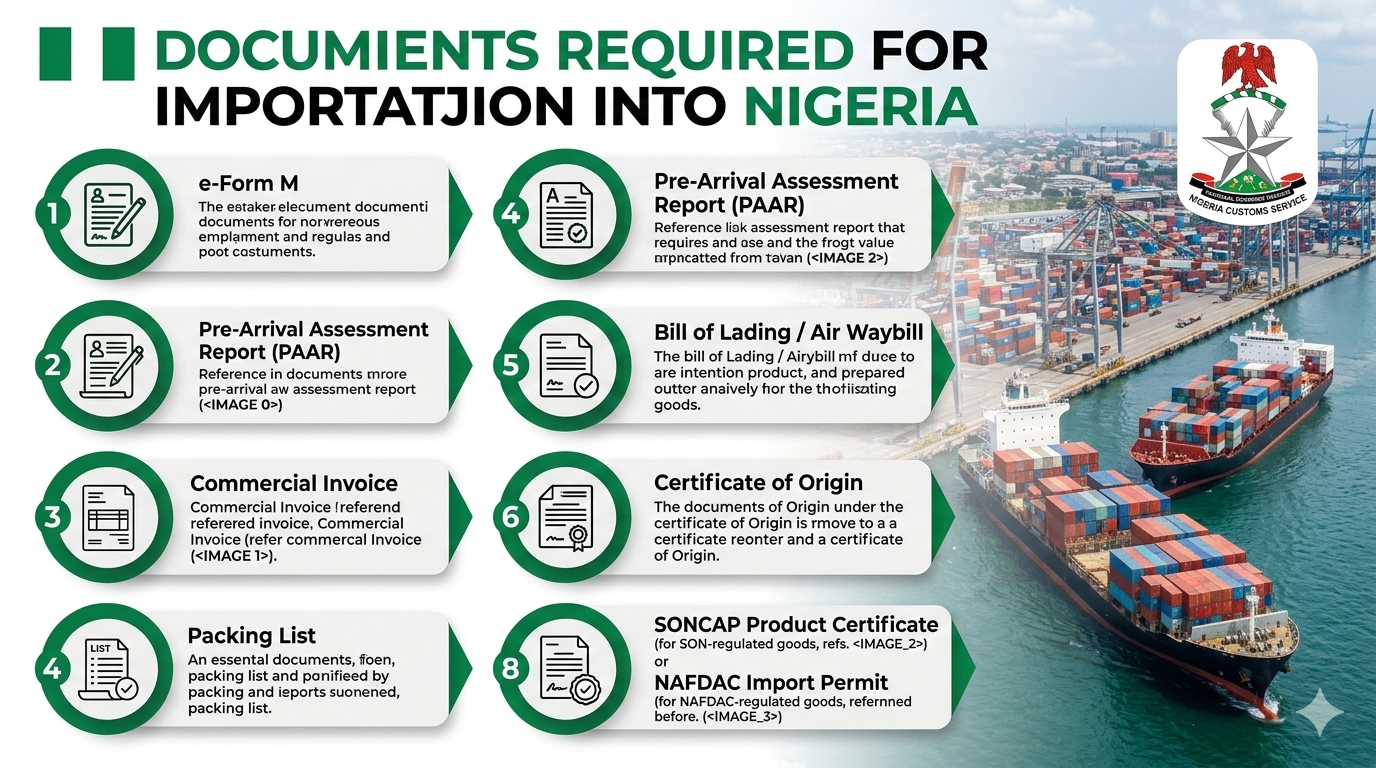
Importing goods into Nigeria can be highly profitable but only when documentation is properly handled. Many shipments are delayed at Nigerian ports and airports not because of unpaid duties, but because of incomplete or incorrect paperwork. Understanding the documents required for importation into Nigeria is essential for smooth customs clearance and avoiding unnecessary penalties.
This guide explains the key documents every Nigerian importer must prepare before shipping goods into the country.
Why Import Documentation Is Important
Nigeria has structured import regulations managed by the Nigeria Customs Service (NCS) and other regulatory agencies.
Proper documentation ensures:
- Smooth customs clearance
- Accurate duty assessment
- Avoidance of cargo seizure
- Prevention of demurrage charges
- Faster cargo release
Core Documents Required for Importation into Nigeria
Below are the essential documents required for most imports.
1️. Form M
Form M is one of the most important documents for importation into Nigeria. It is processed through an authorized commercial bank and registered with customs before shipment.
Purpose of Form M:
- Declares intention to import goods
- Captures product details
- Determines applicable duties and regulations
- Enables Pre-Arrival Assessment Report (PAAR) processing
Form M must be opened before shipment leaves the exporting country.
2️. Proforma Invoice
The proforma invoice is issued by the supplier and contains:
- Description of goods
- Quantity
- Unit price
- Total value
- HS code (if available)
- Supplier and buyer information
This document is required to initiate Form M processing.
3️. Commercial Invoice
After shipment, the supplier provides a commercial invoice. It includes:
- Final agreed price
- Shipment details
- Buyer and seller information
- Terms of trade (Incoterms)
Customs uses the commercial invoice to calculate import duties.
4️. Packing List
The packing list provides detailed cargo breakdown:
- Number of cartons or packages
- Weight (gross and net)
- Dimensions
- Packaging type
This helps customs verify shipment contents during inspection.
5️. Bill of Lading (Sea Freight) or Airway Bill (Air Freight)
Bill of Lading (B/L)
Used for ocean freight shipments.
It serves as:
- Proof of shipment
- Title document
- Contract of carriage
Airway Bill (AWB)
Used for air freight shipments.
It functions as:
- Cargo receipt
- Transportation agreement
Without this document, goods cannot be cleared.
6️. Pre-Arrival Assessment Report (PAAR)
PAAR is issued by Nigeria Customs after Form M processing. It contains:
- Customs valuation
- Applicable duty amount
- Product classification
PAAR must be obtained before cargo arrival to avoid clearance delays.
7️. SONCAP Certificate (If Applicable)
For regulated products, a SONCAP (Standards Organisation of Nigeria Conformity Assessment Programme) certificate may be required.
This applies to goods such as:
- Electronics
- Machinery
- Building materials
- Electrical appliances
It ensures imported products meet Nigerian standards.
8️. NAFDAC Permit (For Regulated Goods)
If importing:
- Food products
- Cosmetics
- Pharmaceuticals
- Chemicals
Approval from NAFDAC (National Agency for Food and Drug Administration and Control) is required.
9️. Insurance Certificate
Marine insurance is often required for international shipments. It protects cargo against:
- Damage
- Loss
- Theft
Insurance may also be required for Form M processing.
10️. Customs Declaration (Single Goods Declaration – SGD)
This is submitted by a licensed customs clearing agent through the Nigeria Customs electronic system. It officially declares:
- Cargo value
- HS code
- Duty payable
- Importer details
Additional Documents (When Applicable)
Depending on the type of goods, you may also need:
- Certificate of Origin
- Import Permit
- Phytosanitary Certificate (for agricultural products)
- Combined Certificate of Value and Origin (CCVO)
Common Documentation Mistakes to Avoid
Many importers experience delays due to:
- Incorrect HS code classification
- Under-declaration of cargo value
- Incomplete Form M details
- Mismatch between invoice and packing list
- Late PAAR processing
Documentation errors can result in:
- Delays
- Additional customs queries
- Fines and penalties
- Cargo seizure
Working with an experienced freight forwarding and customs clearance company reduces these risks.
How to Ensure Smooth Import Clearance in Nigeria
To avoid clearance delays:
✔ Open Form M before shipment
✔ Ensure accurate product classification
✔ Work with licensed customs agents
✔ Confirm documentation consistency
✔ Prepare regulatory approvals in advance
Proper coordination between supplier, freight forwarder, and clearing agent is essential.
Understanding the documents required for importation into Nigeria is crucial for successful international trade. Complete and accurate documentation ensures:
- Faster customs clearance
- Reduced port charges
- Lower risk of penalties
- Smooth delivery to your warehouse
Importing into Nigeria is not complicated but it requires proper preparation and professional logistics coordination.
If you are planning to import goods soon, ensuring all documentation is correctly processed will save time, money, and stress. Contact Super Moonlight Logistics the best logistics company in Lagos Nigeria for more.
